
Brush Cutting vs Forestry Mulching: Choosing Property Maintenance Services in Eastern North Carolina
If you own rural or residential property in Hubert, North Carolina, or anywhere in Eastern North Carolina, you've probably encountered overgrown brush, vines, saplings, and invasive vegetation. A question we receive at Winter Patriots Land Services is, "What's the difference between brush cutting and forestry mulching?" Understanding the different types of vegetation management helps property owners choose the right service, avoid unnecessary expense, and set realistic expectations for the finished product.
After each job, I like to ask customers how the result compares to what I described during our consultation. There have been a couple instances where the finished product wasn’t exactly what the customer was expecting. So, I wanted to take some time to compare some different methods of brush management and help our customers understand their options.
All brush clearing services don’t produce the same result. There are several different methods of vegetation management, each designed for a different purpose, budget, and long-term objective. Understanding these differences helps property owners choose the right service and set realistic expectations before work begins.
Brush Cutting
Brush cutting is the service most property owners are familiar with. Most folks have seen or used a “bush hog” or rotary cutter on a typical tractor. Winter Patriots Land Services uses heavy-duty rotary cutter on a compact track loader to mow and shred vegetation such as briars, saplings, vines, tall grass, and dense brush.
This process leaves the root systems in place while reducing the vegetation to a manageable height. It is one of the fastest and most affordable ways to reclaim overgrown property, improve access, reduce fire hazards, and prepare land for future maintenance.
However, brush cutting is not intended to create a finished surface. Stumps, roots, uneven ground, rocks, and existing terrain remain. While vegetation is greatly reduced, the property will not be suitable for residential lawn mowing immediately after service.
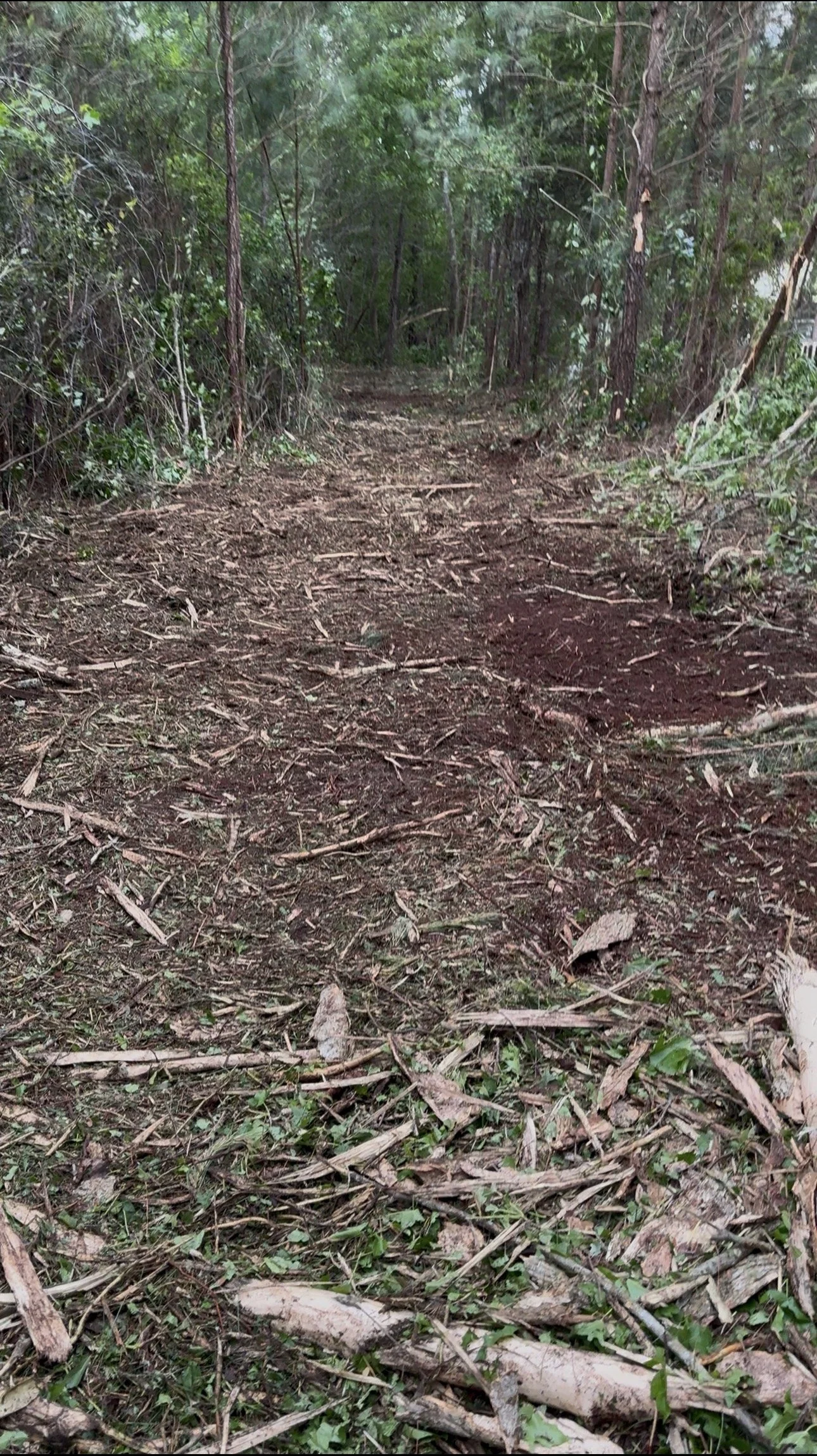
Brush Cutting Results
This site consisted of heavy vegetation and small to medium trees. Brush cutting does not remove stumps or leave behind finely mulched material.
Brush cutting is a maintenance practice, not a land conversion process.
Forestry Mulching
Forestry mulching uses specialized equipment with a high-powered mulching head that grinds trees and brush into fine wood chips.
Unlike brush cutting, forestry mulching can process much larger trees and creates a heavier mulch layer across the ground. It is often used for trail creation, right-of-way clearing, habitat improvement, and larger land clearing projects.
Although forestry mulching produces a cleaner appearance than brush cutting, it still leaves the root systems underground. The resulting mulch layer also takes time to decompose.
Subsoil Mulching
Subsoil mulching goes a step further by mechanically working below the soil surface to break up root mats and underground vegetation.
This process can significantly reduce future brush regrowth but is much more aggressive than standard brush management. It disturbs the soil, requires specialized equipment, and is considerably more expensive.
Subsoil mulching is generally reserved for projects where complete site redevelopment is planned rather than routine property maintenance.
Grubbing
Grubbing is the removal of stumps, roots, root balls, and underground vegetation.
This service is commonly performed before construction, driveway installation, utilities, or finish grading. Because roots are physically removed, grubbing leaves the soil heavily disturbed and typically requires additional grading, imported fill, or erosion control before the property is stabilized.
Grubbing provides one of the cleanest starting points for development but is also among the most labor-intensive and expensive vegetation removal methods.
Chemical Vegetation Management
Chemical management uses herbicides to control unwanted vegetation by killing existing plants and preventing regrowth.
When properly selected and applied, herbicides can be an effective long-term tool for controlling invasive species, woody brush, and aggressive regrowth.
Chemical management is often used alongside mechanical clearing rather than as a standalone solution.
Why We Don't Always Remove Every Root
Many overgrown properties contain a mixture of small brush growing beneath mature hardwoods or established pine stands.
Removing roots through subsoil mulching, aggressive grubbing, chemical treatment, or stripping away large amounts of topsoil can damage the root systems of desirable trees. In some cases, mature trees may become stressed, decline over time, or die.
Healthy mature trees rely on extensive root systems that often extend well beyond the visible canopy. Disturbing those roots simply to eliminate small brush can create far greater problems than the brush itself.
For wooded properties where preserving mature trees is the priority, a less aggressive approach is often the better long-term solution.
Winter Patriots Brush Cutting Service
Our advertised brush cutting service uses a heavy-duty rotary cutter designed to reduce heavy vegetation efficiently and economically.
This service is intended to:
Cut thick brush, vines, saplings, and overgrowth to a manageable height.
Restore access to neglected property.
Improve visibility and usability.
Begin the process of reclaiming overgrown land.
It is not intended to:
Produce a finish-grade surface.
Remove roots or underground vegetation.
Create residential lawn mower-ready ground.
Eliminate future brush growth.
The existing terrain, root systems, stumps, rocks, and natural contours remain after brush cutting.
Reclaiming Overgrown Land Takes Time
Brush encroachment does not happen in a single season. Dense root mats, invasive vines, briars, and woody vegetation often develop over many years.
For that reason, restoring neglected property is usually a process rather than a one-time event.
The first brush cutting establishes control over the vegetation. Future maintenance becomes easier and less expensive because new growth can be managed before it becomes dense again.
Without ongoing maintenance, however, disturbed soil, increased sunlight, and available moisture create ideal conditions for brush to return. This is why reclaimed areas that are left unattended often become overgrown again within a few growing seasons.
The Most Cost-Effective Approach
For many rural properties, hunting land, farms, trails, and homesites, periodic brush cutting offers the best balance between cost and results.
If investing in expensive root removal or aggressive soil disturbance is not in your budget, regular maintenance keeps vegetation under control while preserving desirable trees and minimizing damage to the landscape.
Every property has different goals. Some projects require finish grading and complete site preparation. Others simply need safe access, improved appearance, and manageable vegetation. Understanding the differences between brush management methods allows you to select the service that matches both your objectives and your budget while preserving the long-term health of your property.
At Winter Patriots Land Services, we want customers to understand exactly what they are purchasing before work begins. Whether your property needs routine brush cutting, long-term vegetation management, or preparation for future development, selecting the right service can save both time and money.
We proudly serve Hubert, North Carolina, and communities throughout Eastern North Carolina, providing honest recommendations and dependable land management services tailored to each property's goals.
